Best Canned Protein, Ranked: 25 Tins by Protein Per Dollar (Canadian Prices)
We priced 25 canned proteins at Walmart and Metro and ranked them by cost per gram of protein using USDA drained-solids protein data. Store-brand light tuna wins at 4.1¢ per gram; canned chicken costs 3.6x more.
Part of The Protein Atlas — your complete guide to protein.
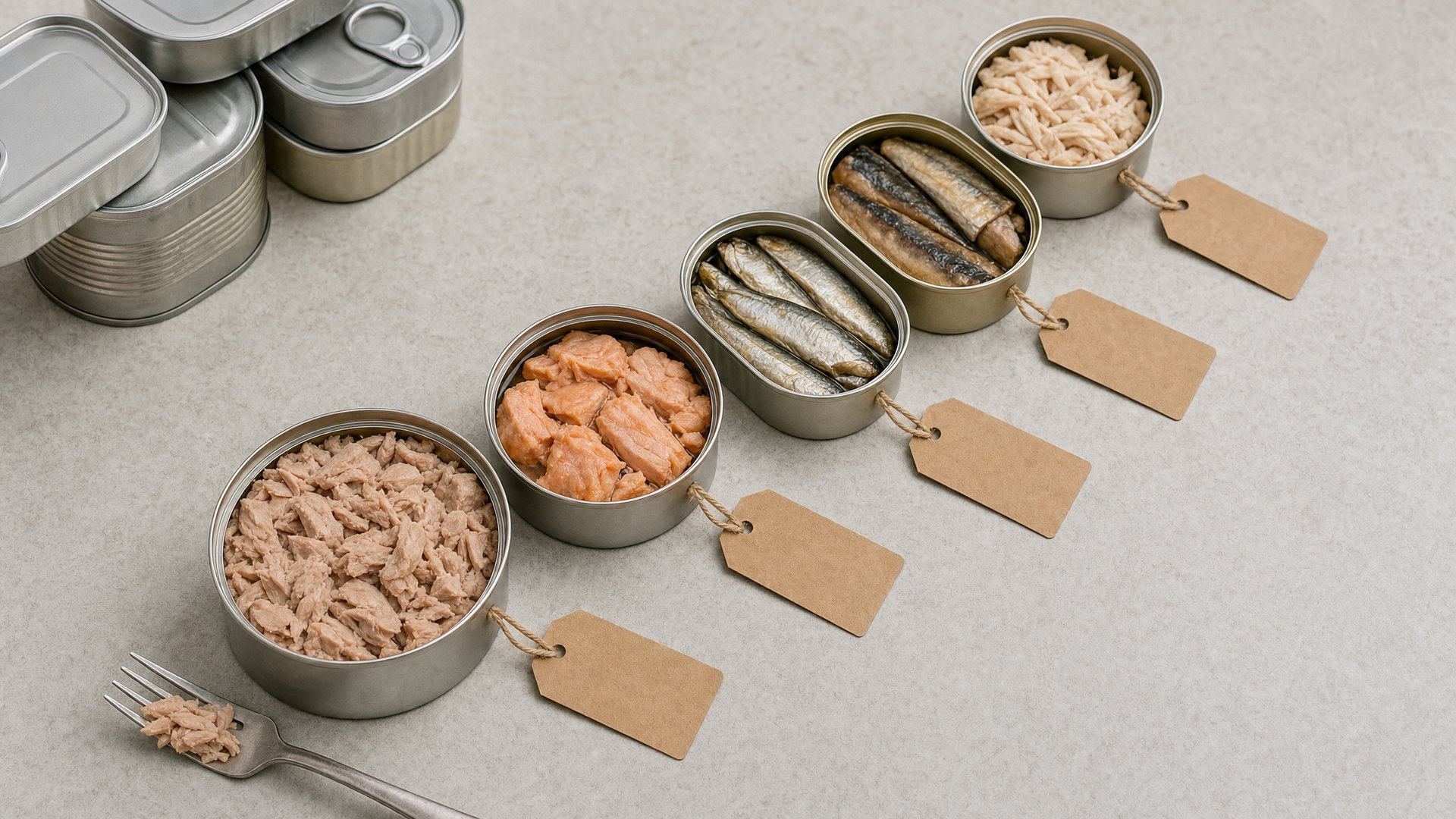
The best canned protein we found in Canada is the cheapest tin on the shelf: store-brand flaked light tuna, at about 4.1¢ per gram of protein. It beats every canned salmon, every sardine, and every canned chicken we priced — and by USDA numbers it edges out the albacore sitting right beside it on protein density too. We priced 25 tins at Walmart and Metro, anchored each one to a USDA drained-solids entry, and ranked them two ways: protein per dollar, and protein per drained 100 grams.
The plain store-brand tin everyone walks past is the best protein deal in the canned aisle.
Buy flaked light tuna as your default tin. Here’s the full move, from 25 tins priced July 12, 2026:
- Default tin: store-brand flaked light tuna — $1.24 at Walmart for a 170g can, ≈30.6g of protein, 4.1¢ per gram of protein. The runner-up tin costs about a third more per gram.
- Bulk buy: the 443g jack mackerel can ($3.77) — ≈69.6g of protein in one tin at 5.4¢/g, the cheapest way to feed several people from one can.
- Salmon: buy pink, and buy the big can. The 418g pink salmon can (8.7¢/g) runs about 17% cheaper per gram than the 213g can (10.5¢/g). Sockeye costs 42% more per gram of protein than pink for nearly identical protein; the extra money buys colour and flavour.
- Skip for protein: canned chicken — 14.5¢/g at its cheapest, about 3.6x the cost of light tuna.
- Read the drained weight on tomato-sauce tins. The net weight includes the sauce, so the cheapest-looking can on the shelf isn’t as cheap as its sticker math suggests.
Most “best canned protein” lists rank tins by protein per serving, which mostly measures how big the serving is. We ranked by the number that answers the actual question — how much does a gram of protein cost? — and by protein per drained 100 grams for anyone optimizing density instead of dollars. For scale: the cheap end of the canned aisle sits at 4.1¢ per gram of protein, the mid-pack (sardines, albacore, small salmon cans) runs 10-15¢, and the premium outlier (anchovies) hits 69.1¢. And one basic worth stating outright: every tin here — fish and chicken alike — is fully cooked in the can, so it’s safe to eat cold straight from the tin or heated, your call.
What’s the Cheapest Canned Protein in Canada?
Here’s each category at its best regular price, cheapest first (the full 25-row dataset is further down). The column that matters is ¢/g protein — cents (CAD) per gram of protein, computed on drained weight rather than the net weight printed on the can.
| Rank | Product (best regular price) | ¢/g protein | Price | Protein/can g ≈ |
|---|---|---|---|---|
| 1 | Flaked light tuna in water, 170g (Great Value, Walmart) | 4.1 | $1.24 | 30.6 |
| 2 | Jack mackerel in brine, 443g (Grace, Walmart) | 5.4 | $3.77 | 69.6 |
| 3 | Mackerel in tomato sauce, 155g (Grace, Walmart)† | 6.3 | $1.38 | 22.0 |
| 4 | Sardines in tomato sauce, 155g (AA-1/Grace, Walmart) | 6.4 | $1.27 | 19.9 |
| 5 | Pink salmon, 418g (Clover Leaf, Walmart) | 8.7 | $7.57 | 86.9 |
| 6 | Solid white albacore tuna, 170g (Great Value, Walmart) | 10.5 | $2.97 | 28.3 |
| 7 | Pink salmon, 213g (Clover Leaf, Walmart) | 10.5 | $4.64 | 44.4 |
| 8 | Sardines in spring water, 106g (Brunswick, Walmart) | 11.0 | $2.17 | 19.7 |
| 9 | Kippered herring fillets, 85g (Brunswick, Metro) | 14.3 | $2.99 | 20.9 |
| 10 | Chicken flakes, 156g (Maple Leaf, Walmart) | 14.5 | $3.57 | 24.6 |
| 11 | Sockeye salmon, 213g (Clover Leaf, Walmart) | 14.9 | $6.74 | 45.3 |
| 12 | Premium mackerel fillets, 169g (Petit Navire, Metro) | 23.0 | $6.29 | 27.4 |
| 13 | Anchovy fillets in olive oil, 48g (Pastene, Metro) | 69.1 | $5.99 | 8.7 |
Prices browser-verified July 12, 2026 at Walmart.ca and Metro.ca (regular prices; promos ignored — see methodology). “Brine” in a product name just means salt water. Protein per can is drained weight × USDA protein per 100g of drained solids; the ≈ is honest, because drained weights are label-standard estimates, not our own scale. †No tomato-pack USDA entry exists for mackerel, so this row borrows the brine-drained value — read 6.3 as an optimistic bound (details in the tomato-sauce section).
The TL;DR above is the shopping list. Four things in this table didn’t make it:
- The “premium” tuna fails on both axes. The Great Value albacore in the identical 170g can costs 2.4x the light tuna and holds less protein per can (≈28.3g vs ≈30.6g). The full head-to-head is below.
- The cheapest-looking tin isn’t. The $1.27 tomato-sauce sardines pencil out around 3.9¢/g if you use the weight printed on the front — but roughly 60g of that can is sauce. The honest drained-weight figure is 6.4¢/g, which still lands them in the top five.
- Anchovies aren’t a protein source; they’re a seasoning. At 69.1¢/g — $12.48 per 100g of net weight — they’re in this table only as a labelled premium outlier.
- The #1 spot survives the pickiest protein number. USDA publishes more than one protein value for light tuna; even at the lowest, light tuna holds its rank — though the jack mackerel closes to a near-tie. The sensitivity check is in the methodology.
The rest of this article shows the math behind the table, then unpacks the four decisions hiding inside it: light vs albacore, pink vs sockeye, the tomato-sauce trap, and what to do about mercury.
How Did We Calculate Protein Per Dollar?
One formula, applied 25 times:
protein per can = drained weight × USDA protein per 100g of drained solids ÷ 100, then cost per gram = price ÷ protein per can.
Shown in full for the headline number: a 170g Great Value can of flaked light tuna drains to roughly 120g of fish (the Canadian label standard for 170g tuna cans). USDA FoodData Central lists light tuna canned in water, drained solids, at 25.5g of protein per 100g (FDC 171986). So 120 × 25.5 ÷ 100 = ≈30.6g of protein per can, and $1.24 ÷ 30.6 = $0.0405 — 4.1¢ per gram of protein.
“Drained solids” means exactly what it sounds like: the fish left after you pour off the water, brine (salt water), oil, or sauce. USDA publishes protein values for drained solids specifically, which is why we can rank on the food you actually eat rather than the liquid you pour down the sink.
Everything else you should know before trusting the table:
- Prices are a two-retailer snapshot. Browser-verified July 12, 2026 at Walmart.ca and Metro.ca, Toronto-area online prices. We tried to include Loblaws banners (Loblaws, No Frills, Superstore) but their site blocked automated price verification — so they’re not represented, and their store brands may undercut some rows. Seven of the 25 products were on promo or rollback (Walmart’s term for a temporary price cut) the day we checked (Ocean’s chunk light was down to $1.17); we recorded regular prices for all of them, so your shelf price on any given week may be lower.
- Drained weights are estimates, not measurements — the one soft joint in the math. The USDA protein-per-100g values are verified; the per-can drained masses are label and industry standards: 170g tuna → ~120g, salmon → net minus about 10% (salmon is packed in its own juices, no added water), 106g sardines → 75-85g, 155g tomato-sauce tins → 90-100g of fish, 156g chicken → 105-120g, the 443g mackerel → 290-310g. That’s why every protein-per-can figure carries a ≈. Across those declared ranges, each ¢/g figure moves by roughly ±8% — and the headline calls hold at both ends of every range: light tuna stays first, pink beats sockeye, and chicken stays behind every everyday fish tin (only the premium tins — sockeye, the Petit Navire fillets, anchovies — cost more per gram than it does). The two lowest-confidence rows are the Petit Navire mackerel fillets and the kippered (smoked) herring, which is typically eaten straight from the tin, liquid and all.
- One deliberate check: what if the tuna protein number is off? USDA carries a second light-tuna entry (FDC 173709) at just 19.4g/100g, and Canadian labels imply values around 22.5-23.6. We use 25.5 (FDC 171986), the same entry as the rest of this site and the standard drained-solids value. If the true number were as low as 19.4, Great Value light tuna would cost 5.3¢/g — still #1, but with the jack mackerel (5.4¢) close enough to call it a tie, and albacore would edge it on density. So the claim we’ll stand behind is: at every plausible protein value, light tuna is either the cheapest tin or in a dead heat with the jack mackerel for it. The exact 4.1¢ figure depends on the USDA entry you pick.
- This is arithmetic, disclosed as such. Protein per can is drained weight times USDA density — simple multiplication. The two independently verified facts per row are the price and the USDA value — though a few rows borrow a neighbouring USDA entry, flagged where that happens; the drained weight is the estimate in between.
- The two sardine rows share one USDA entry. USDA’s drained-solids anchor for sardines (FDC 175139) is measured on oil-packed fish; we apply it to the spring-water tin as well, since it’s the standard drained-solids entry and the one used across this site. Treat the water-pack row’s density as the best available estimate, the same way the tomato-sauce mackerel row (flagged below) borrows the brine-drained entry.
- This is a market scan of 25 products. Nine categories from budget to premium — wide enough to rank the aisle, too small to claim we priced all of it. Canned trout was dropped (neither retailer sells it); anchovies were kept only as a labelled outlier.
Here’s the full dataset, every row:
| Product | Size g | Price | Store | Drained g ≈ | USDA g/100g | Protein/can g ≈ | ¢/g |
|---|---|---|---|---|---|---|---|
| Flaked light tuna in water (Great Value) | 170 | $1.24 | Walmart | 120 | 25.5 | 30.6 | 4.1 |
| Flaked light tuna in water (Selection) | 170 | $1.49 | Metro | 120 | 25.5 | 30.6 | 4.9 |
| Flaked light tuna, skipjack (Clover Leaf) | 170 | $1.88 | Walmart | 120 | 25.5 | 30.6 | 6.1 |
| Chunk light tuna (Ocean’s) | 170 | $1.97 | Walmart | 120 | 25.5 | 30.6 | 6.4 |
| Flaked light tuna in water (Clover Leaf) | 170 | $2.49 | Metro | 120 | 25.5 | 30.6 | 8.1 |
| Solid white albacore (Great Value) | 170 | $2.97 | Walmart | 120 | 23.6 | 28.3 | 10.5 |
| Solid white albacore (Clover Leaf) | 170 | $3.77 | Walmart | 120 | 23.6 | 28.3 | 13.3 |
| Solid white albacore (Clover Leaf) | 170 | $3.99 | Metro | 120 | 23.6 | 28.3 | 14.1 |
| Pink salmon (Clover Leaf) | 213 | $4.64 | Walmart | 192 | 23.1 | 44.4 | 10.5 |
| Pink salmon (Clover Leaf) | 213 | $6.29 | Metro | 192 | 23.1 | 44.4 | 14.2 |
| Pink salmon, large (Clover Leaf) | 418 | $7.57 | Walmart | 376 | 23.1 | 86.9 | 8.7 |
| Pink salmon, large (Gold Seal) | 418 | $9.29 | Metro | 376 | 23.1 | 86.9 | 10.7 |
| Sockeye salmon (Clover Leaf) | 213 | $6.74 | Walmart | 192 | 23.6 | 45.3 | 14.9 |
| Sockeye salmon (Clover Leaf) | 213 | $8.99 | Metro | 192 | 23.6 | 45.3 | 19.8 |
| Sardines in spring water (Brunswick) | 106 | $2.17 | Walmart | 80 | 24.6 | 19.7 | 11.0 |
| Sardines in water/soya oil (Brunswick) | 106 | $2.79 | Metro | 80 | 24.6 | 19.7 | 14.2 |
| Sardines in tomato sauce (AA-1/Grace) | 155 | $1.27 | Walmart | 95 | 20.9 | 19.9 | 6.4 |
| Mackerel in tomato sauce (Grace) | 155 | $1.38 | Walmart | 95 | 23.2 | 22.0 | 6.3 |
| Jack mackerel in brine, large (Grace) | 443 | $3.77 | Walmart | 300 | 23.2 | 69.6 | 5.4 |
| Mackerel fillets, premium (Petit Navire) | 169 | $6.29 | Metro | 118 | 23.2 | 27.4 | 23.0 |
| Chicken flakes (Maple Leaf) | 156 | $3.57 | Walmart | 113 | 21.8 | 24.6 | 14.5 |
| Chicken flakes (Selection) | 156 | $3.79 | Metro | 113 | 21.8 | 24.6 | 15.4 |
| Chicken flakes (Maple Leaf) | 156 | $4.69 | Metro | 113 | 21.8 | 24.6 | 19.0 |
| Kippered herring fillets (Brunswick) | 85 | $2.99 | Metro | 85 | 24.6 | 20.9 | 14.3 |
| Anchovy fillets in olive oil (Pastene) | 48 | $5.99 | Metro | 30 | 28.9 | 8.7 | 69.1 |
Every row recomputes from its primitives — price, drained weight, USDA density — and the full dataset with FDC IDs and sources is checked by an automated validator before publish. If a number here can’t be reproduced from its sources, the article doesn’t ship.
Is Albacore Worth 2.4x the Price of Light Tuna?
Not for protein. This is the clearest head-to-head in the data, because you can hold everything else constant: same brand, same store, same 170g can.
| Great Value, 170g at Walmart | Light tuna (flaked) | Albacore (solid white) |
|---|---|---|
| Price | $1.24 | $2.97 |
| USDA protein, g/100g drained | 25.5 | 23.6 |
| Protein per can ≈ | 30.6 | 28.3 |
| ¢/g protein | 4.1 | 10.5 |
The albacore costs 2.4x as much per can — for less protein. Per gram of protein it’s about 2.6x the cost. And this isn’t a store-brand quirk: Clover Leaf albacore runs 13.3-14.1¢/g against 6.1-8.1¢/g for Clover Leaf light tuna.
Quick vocabulary, because the labels don’t explain themselves: light tuna is smaller tuna species — mostly skipjack, sometimes yellowfin — with darker, softer meat. Albacore (“solid white”) is a larger species with firmer, whiter meat. “Flaked,” “chunk,” and “solid” describe only the size of the pieces in the can; the species and the nutrition come from the “light” or “albacore” on the label.
What albacore actually buys you is texture and appearance: firm white steaks instead of soft flakes. What it does not buy you, per USDA drained-solids entries, is more protein — light tuna carries 25.5g per 100g drained against albacore’s 23.6. (USDA light-tuna entries vary, and at the lowest published value albacore would edge ahead on density. At no published value does it come close on cost.) Albacore is also the tuna with the mercury consumption limits — covered below.
If you’re mixing tuna into a rice bowl, lettuce wraps, or anything with sauce and seasoning, the texture difference disappears and the price difference doesn’t.
Pink or Sockeye: Which Canned Salmon Is the Better Buy?
Pink, unless you’re buying for colour and flavour. Clover Leaf, 213g, Walmart — the only thing that changes is the fish:
| Clover Leaf, 213g at Walmart | Pink salmon | Sockeye salmon |
|---|---|---|
| Price | $4.64 | $6.74 |
| USDA protein, g/100g drained | 23.1 | 23.6 |
| Protein per can ≈ | 44.4 | 45.3 |
| ¢/g protein | 10.5 | 14.9 |
On protein density the two are nearly identical — 23.1 vs 23.6 g/100g drained, about a 2% gap. On cost, sockeye runs 42% more per gram of protein. Sockeye is deeper red, richer, and firmer, and if that’s what you’re paying for, pay for it happily. But as a protein purchase, pink and sockeye are the same product at two prices.
The bigger salmon move is can size. The 418g pink salmon can at $7.57 works out to 8.7¢/g — about 17% cheaper per gram than the 213g can at 10.5¢/g (both Clover Leaf, both at Walmart). One big can holds ≈86.9g of protein, which is exactly the format for a batch of Air Fryer Canned Salmon Patties (35g protein, 290 calories per serving).
And the canned tuna vs canned salmon question, settled on protein economics: light tuna at 4.1¢/g costs roughly half of what the best salmon deal (the 418g pink can, 8.7¢/g) costs per gram of protein. What salmon buys you instead is omega-3s and the calcium in its soft, edible bones — run canned salmon vs canned tuna in that direction and salmon has a real case. The full nutritional head-to-head is in Tuna vs Salmon: Protein, Price, and Which to Actually Buy.
Why Do Tomato-Sauce Tins Look Cheaper Than They Are?
Because the number on the front of the can — net weight — includes the sauce.
The $1.27 sardines in tomato sauce are the cheapest tin on the shelf, and the naive math makes them look like the cheapest protein too: 155g at a sardine-like protein density comes out around 3.9¢ per gram. But roughly 60g of that 155g is tomato sauce. Drain it and you’re holding about 95g of fish — and tomato-packed sardines carry the lowest protein density in our whole set (20.9g/100g drained, versus 24.6 for water-packed sardines). Run the honest math and the real cost is 6.4¢ per gram of protein — about 63% higher than the sticker suggests.
The trap is the math, not the product.
To be clear: even after the correction, both tomato-sauce tins land in the top five for value. The sardines at 6.4¢/g and the Grace mackerel at 6.3¢/g are legitimately cheap protein. One caveat on that mackerel figure: USDA has no tomato-packed mackerel entry, so we used the brine-drained value — its true cost per gram is likely somewhat worse, and 6.3¢ should be read as the optimistic bound.
The lesson generalizes to the whole aisle: compare tins on drained weight, never net weight. Water-packed tuna loses about 50g to liquid; tomato-sauce tins lose 55-65g; salmon loses only about 10% because it’s canned in its own juices. Two cans with the same net weight can hold very different amounts of food.
Which Canned Protein Has the Most Protein Per 100 Grams?
If you’re optimizing density rather than dollars — protein per bite, not per loonie — the ranking reshuffles:
| Rank | Category | Protein g/100g drained | USDA FDC |
|---|---|---|---|
| 1 | Anchovies (oil, drained) | 28.9 | 174183 |
| 2 | Light tuna (water, drained) | 25.5 | 171986 |
| 3 | Sardines (oil, drained, with bone) | 24.6 | 175139 |
| 3 | Kippered herring | 24.6 | 173668 |
| 5 | Albacore tuna (water, drained) | 23.6 | 175158 |
| 5 | Sockeye salmon (drained) | 23.6 | 173693 |
| 7 | Jack mackerel (drained) | 23.2 | 175121 |
| 8 | Pink salmon (drained) | 23.1 | 175175 |
| 9 | Canned chicken (with broth) | 21.8 | 171099 |
| 10 | Sardines in tomato sauce (drained, with bone) | 20.9 | 175140 |
Anchovies top the density table, but at 69.1¢ per gram of protein they’re a flavour bomb you use three fillets at a time. Among tins you’d actually eat as a meal, light tuna wins both rankings — cheapest per dollar and, by the standard USDA entries, densest per 100 grams. That’s the quiet headline of this whole exercise: the budget pick and the density pick are the same tin.
The bottom of the table tells the same story from the other side: canned chicken and tomato-packed sardines are the least protein-dense tins in the set, and chicken is expensive on top of it.
Density matters most if you’re eating for a calorie budget as well as a dollar budget. Canned fish in water is nearly pure protein, and protein has the highest thermic effect of the macronutrients — digesting it burns roughly 25-30% of its own calories, versus 5-10% for carbohydrate and 0-3% for fat. For the full per-calorie picture across all foods, see Protein Per Calorie, Ranked.
What About Mercury in Canned Tuna?
The short version: the mercury concern in canned tuna is mostly an albacore concern, and even there it’s a limit for specific groups, not a danger label.
Health Canada’s consumption guidance sets limits for canned albacore (white) tuna — the larger species accumulates more mercury — and only for specific groups: up to 300g per week for women who are or may become pregnant or are breastfeeding, 150g per week for children five to eleven, and 75g per week for children one to four. There is no specific limit for canned light tuna (skipjack and yellowfin — smaller, shorter-lived species that accumulate less mercury), and no albacore limit for the general adult population (source: Health Canada, “Mercury in Fish” consumer guidance, canada.ca, verified July 2026).
So the value pick and the lower-mercury pick are the same tin. If you’re in one of the groups above and prefer albacore, the guidance is a weekly cap to track — roughly 1.8 to 2.5 cans a week for the 300g limit, depending on whether you count the can’s net weight (170g) or just the drained fish (about 120g) — not a reason to avoid the aisle. And if albacore is your main protein source week after week, Health Canada’s broader advice applies even outside the listed groups: vary your protein sources.
What Should You Actually Stock?
The decision framework, by what you’re optimizing for:
- Cheapest protein, single servings: flaked light tuna, store brand — stock several tins at a time (unopened, they keep for years). Each $1.24 tin is ≈30.6g of protein — dump one over rice with edamame and you’ve got the 5-Minute Canned Tuna Protein Bowl at 45g of protein for 404 calories. At 4.1¢ a gram, even an aggressive 140g-of-protein day built on light tuna alone would run only about $5.70 — an illustrative floor, not a meal plan.
- Cheapest protein, feeding several people: the 443g jack mackerel can (≈69.6g protein, $3.77) or the 418g pink salmon (≈86.9g, $7.57). Mash either into patties, pasta, or fish cakes — these air-fryer salmon patties are the template. If you don’t finish a big can in one sitting, move the leftovers out of the tin into a sealed container in the fridge and eat them within about three days.
- Lowest calories per gram of protein: water-packed light tuna and water-packed sardines. Try them in Tuna Salad Lettuce Wraps (37.4g protein, 368 calories) or scaled up in Mediterranean Tuna Grain Bowls — 42.0g of protein per serving.
- Omega-3s and calcium: canned salmon and sardines, bones in. The bones are soft, edible, and where most of the calcium lives.
- You don’t eat fish: canned chicken works, but know what you’re paying — 14.5¢ per gram of protein at its cheapest, versus 4.1¢ for light tuna. At that price, eggs and fresh chicken thighs are usually the better protein-per-dollar buy (we didn’t price them in this scan); treat canned chicken as an emergency-shelf item.
- Absolute cheapest protein, canned or not: dried beans still win. Our US-price ranking put pinto beans at about $0.011 US per gram of protein against $0.033 US for water-packed tuna — roughly a third of tuna’s cost. Tins buy convenience and zero prep; beans keep the floor price.
Sodium is the one thing the dollar-per-gram math misses. Most canned fish and chicken run moderate-to-high in sodium — salt-brined tins (sardines, anchovies, kippered herring, most canned chicken) sit highest, water-packed tuna and salmon lower, and “no salt added” versions lowest. If you’re tracking sodium, check the label, favour water-packed or unsalted tins, and give a drained tin a quick rinse under the tap to cut it further.
One pantry note from the pricing data: the same 170g can of Clover Leaf light tuna was $1.88 at Walmart and $2.49 at Metro. The store matters almost as much as the tin — and since this ranking uses regular prices, every promo is a chance to buy your default tin below its already-best price.
The Bottom Line
Several tins of store-brand flaked light tuna ($1.24 a tin at Walmart — 4.1¢ per gram of protein, the cheapest and densest everyday tin in the aisle). One 443g jack mackerel or 418g pink salmon can for a batch meal. One tin of sardines for the omega-3s and calcium. Skip the albacore unless you specifically want the firm white texture, skip sockeye unless you’re paying for flavour, and leave the canned chicken on the shelf unless fish is off the table entirely.
And whatever you buy: check the label for a drained weight. Not every can prints one, and it may not match this article’s estimates to the gram — but it’s the number that tells you how much food is actually inside.
Frequently Asked Questions
How much protein is in one can of tuna?
A standard Canadian 170g can of light tuna in water holds about 120g of fish once drained, which works out to ≈30.6g of protein using the USDA drained-solids value of 25.5g per 100g (FDC 171986). Brand labels print anywhere from 22-27g per can depending on the brand and which nutrition basis they use, so treat 30.6g as the USDA-anchored estimate, not a label guarantee.
What is the cheapest canned fish for protein?
Flaked light tuna in water — the store-brand 170g can was $1.24 at Walmart in July 2026, which is 4.1¢ per gram of protein. The runner-up is the big 443g jack mackerel can at 5.4¢ per gram: $3.77 for ≈69.6g of protein in a single tin, the cheapest bulk option in the aisle.
Is canned chicken or canned tuna cheaper per gram of protein?
Canned tuna, by about 3.6x. The cheapest canned chicken we priced works out to 14.5¢ per gram of protein versus 4.1¢ for store-brand light tuna. Canned chicken was more expensive per gram than every canned fish in our 25-tin set except the premium tins — sockeye salmon, Petit Navire mackerel fillets, and anchovy fillets.
Is light tuna or albacore better for you?
For most buyers, light tuna — though it depends on what you’re optimizing. Light tuna is lower in mercury — Health Canada’s tuna consumption limits apply to canned albacore only, and only for specific groups (pregnant and breastfeeding women, young children) — and by USDA drained-solids entries it has slightly more protein per 100g than albacore (25.5 vs 23.6). USDA light-tuna entries vary, so the density edge isn’t ironclad, but the price edge is: albacore costs about 2.6x more per gram of protein. Where albacore wins is firmer, whiter meat and typically more omega-3 fats than light tuna — so if omega-3s are the goal, that’s a point in its favour (canned salmon carries even more).
Do you lose protein when you drain the can?
Essentially no. The protein is in the solids — the water, brine, or oil you pour off carries only a small amount of dissolved protein with it. Draining also matches how most of the USDA values in this ranking are measured — they’re “drained solids” entries — so the drained can lines up with the numbers in our tables.
Is canned salmon with bones safe to eat?
Yes. The canning process pressure-cooks the bones until they’re soft enough to mash with a fork, and they’re where most of the calcium in canned salmon lives. The USDA entries used in this article for pink and sockeye salmon include the skin and bones, as does the sardine entry — eating the whole tin is the intended use.
Want the tins put to work? Start with the 5-Minute Canned Tuna Protein Bowl tonight and a batch of Tuna & Chickpea Cracker Nachos (25.3g protein, about 239 calories) for the weekend.
- Tuna vs Salmon: Protein, Price, and Which to Actually Buy — The full nutritional head-to-head behind this article’s price math.
- The Cheapest Protein Per Gram: 52 Foods Ranked — Where canned fish lands against beans, eggs, chicken, and beef.
- Protein Per Calorie, Ranked — The density side of the story, across every food we track.
Featured Recipes
All 6 recipes from this article, ready to cook
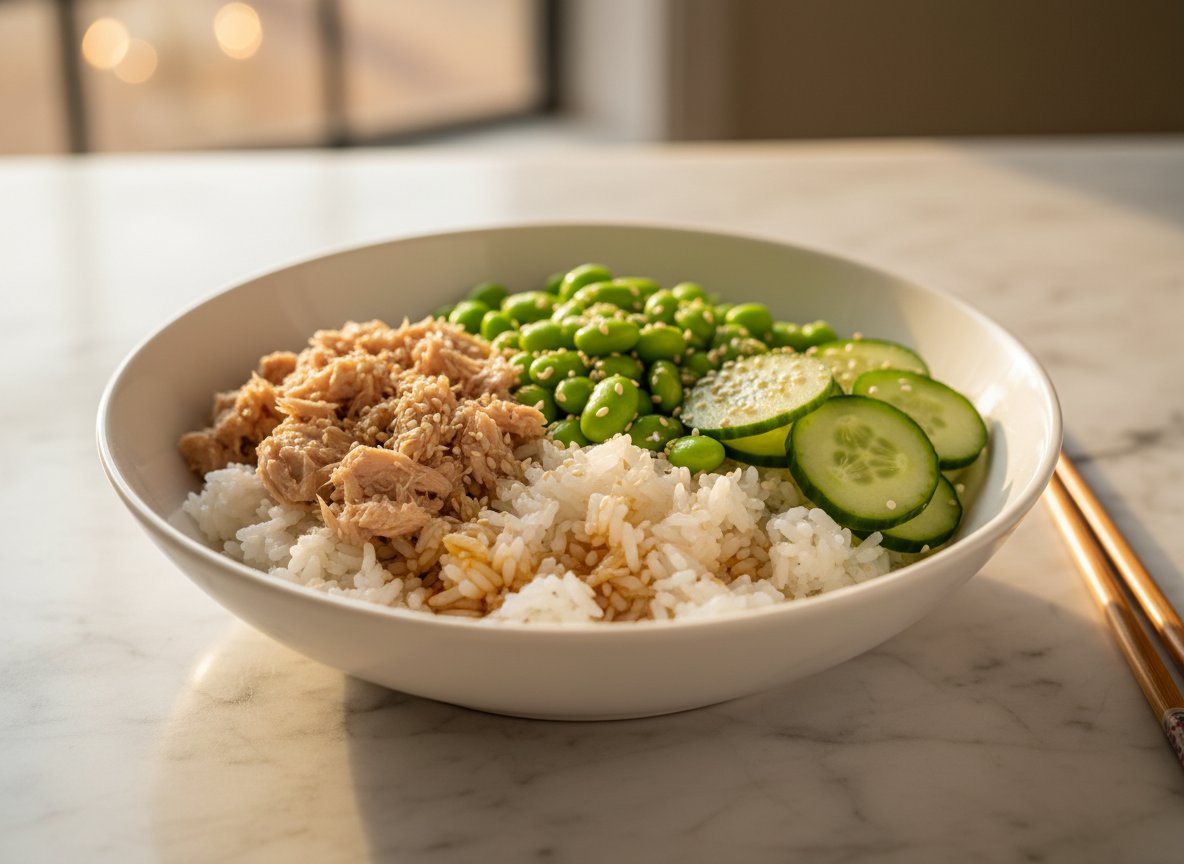
1. 5-Minute Canned Tuna Protein Bowl with Edamame | 45g Protein
One can of tuna, half cup rice, edamame, cucumber, and a soy-sesame drizzle. 45g protein, 404 calories, zero cooking required. Budget meal prep staple.
View Recipe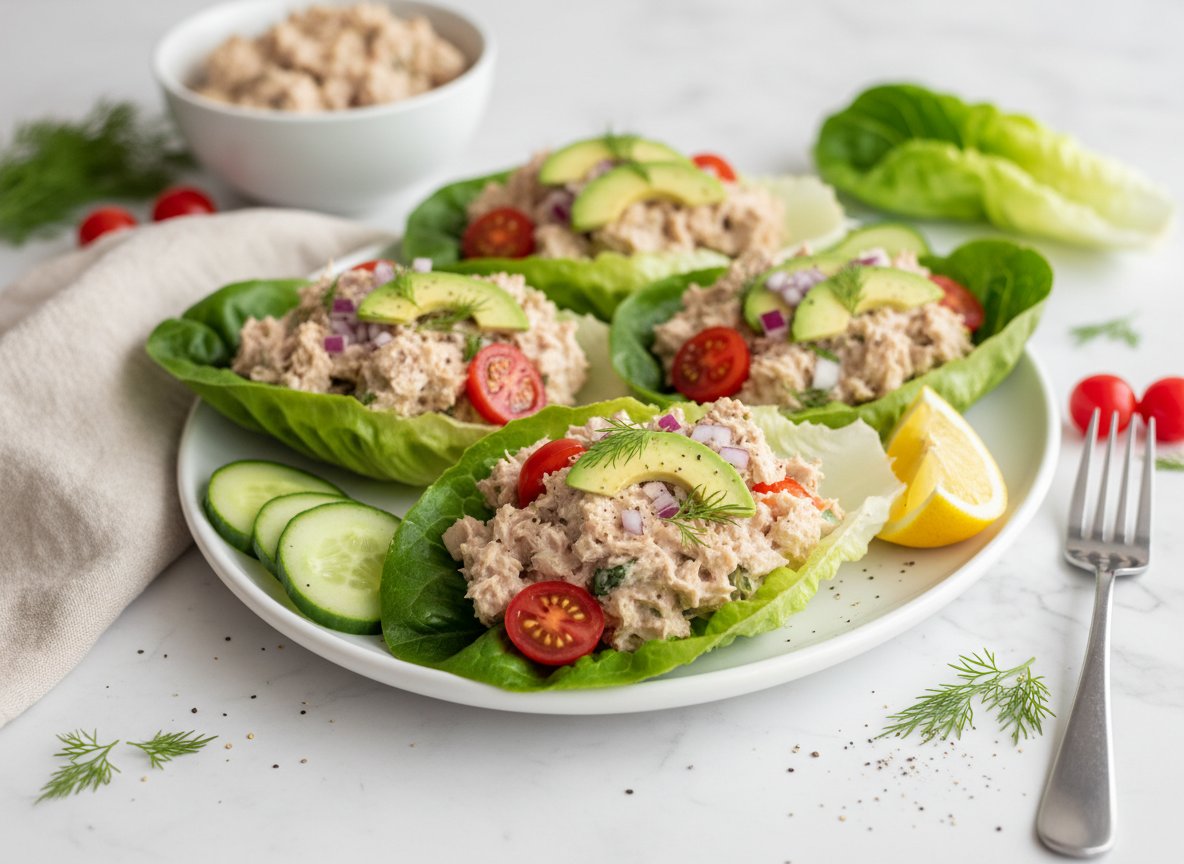
2. Tuna Salad Lettuce Wraps
Lemony tuna salad with crisp celery nestled in fresh butter lettuce cups. 37g protein, 368 cal in just 15 minutes.
View Recipe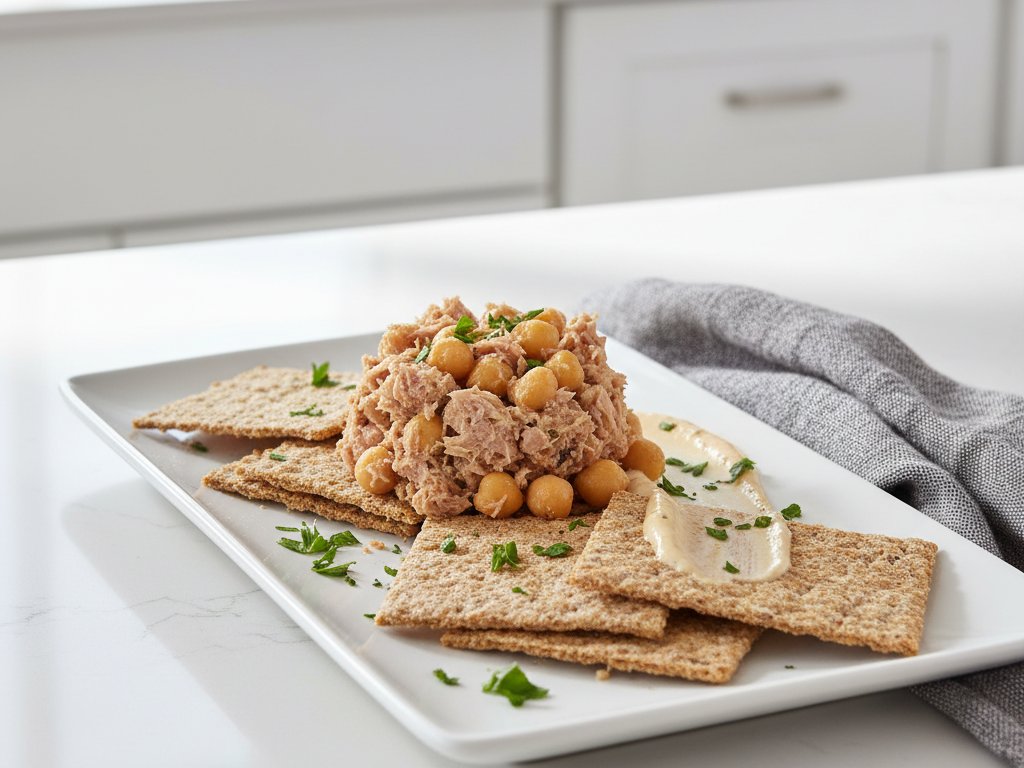
3. Tuna & Chickpea Cracker Nachos
Creamy tuna and mashed chickpeas piled on crispy crackers with cheese and fresh veggies. 25g protein, 239 cal, no cooking needed.
View Recipe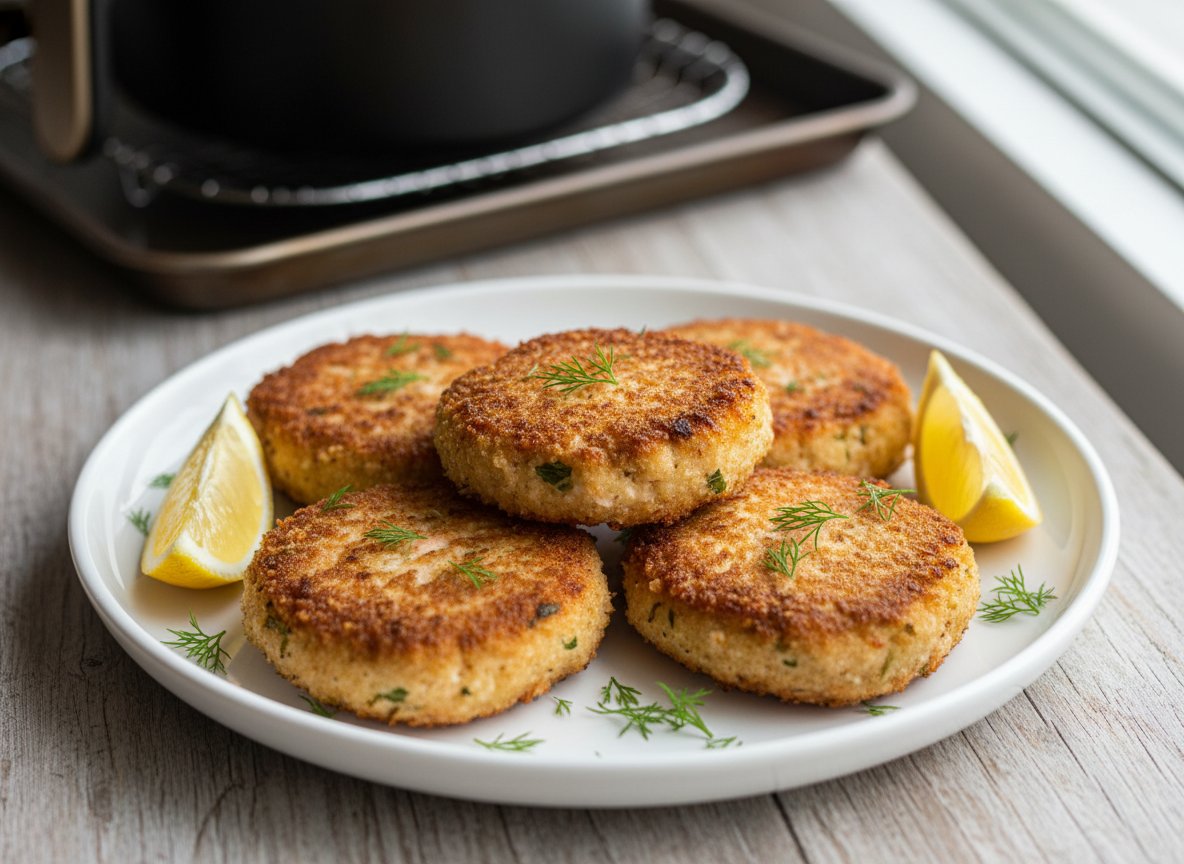
4. Air Fryer Canned Salmon Patties - 35g Protein, 20 Minutes
Crispy canned salmon patties in the air fryer. 35g protein, 290 calories per serving. One 14.75oz can, 20 minutes, 6 patties. USDA-verified nutrition.
View Recipe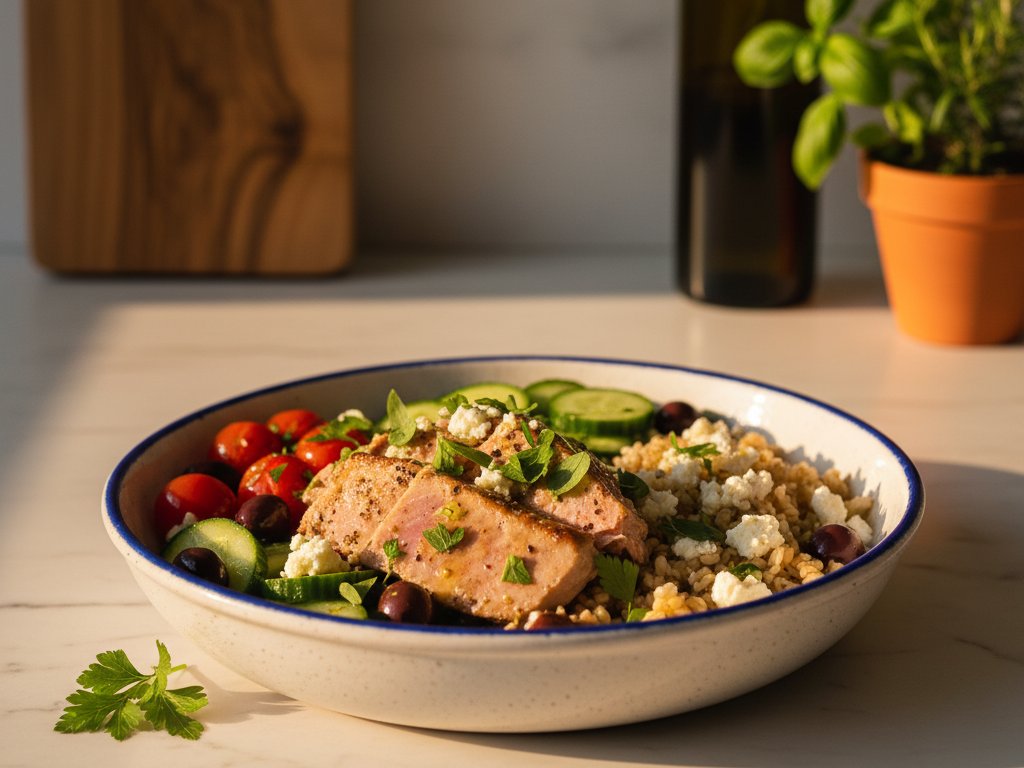
5. Mediterranean Tuna Grain Bowls
Flaky tuna, hearty grains, and bright lemon-herb dressing. 42g protein, 693 cal with zero cooking. Fresh Mediterranean meal prep in 45 min.
View Recipe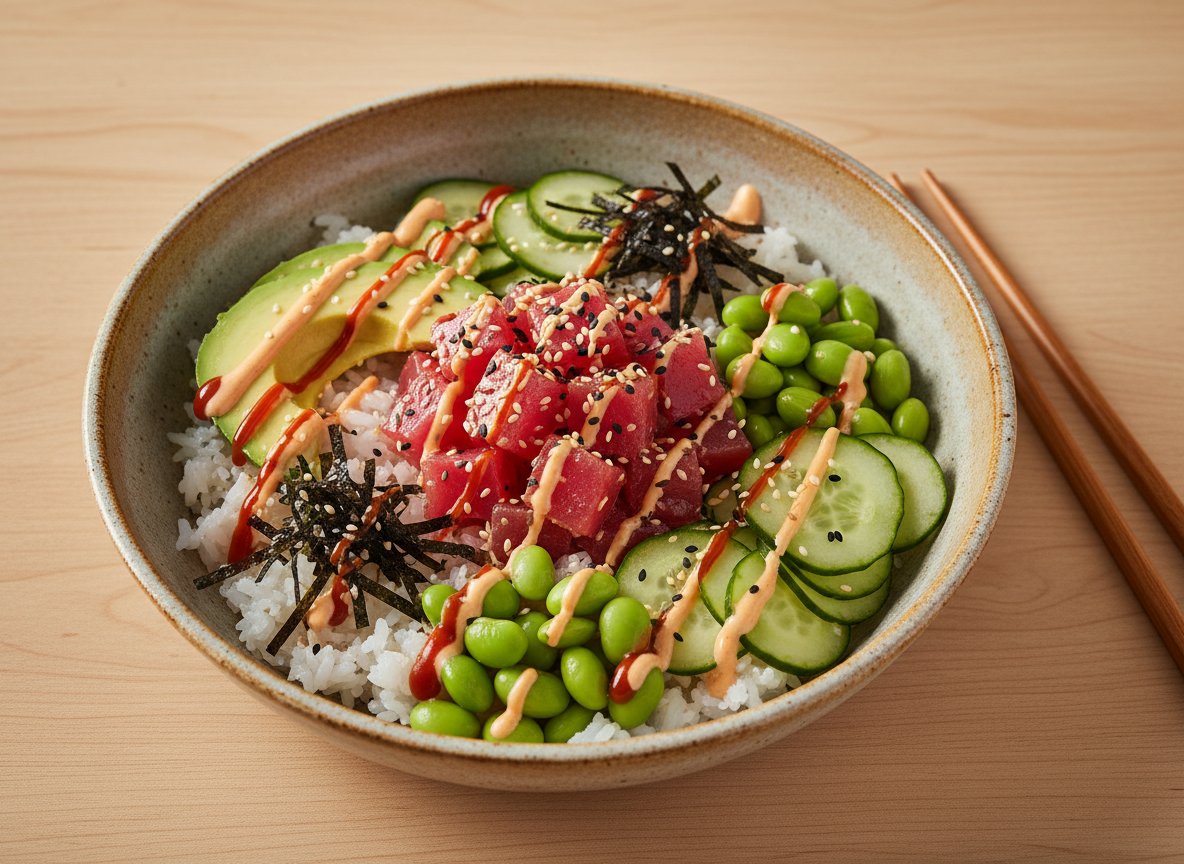
6. Spicy Tuna Rice Bowl with Avocado and Edamame | 34g Protein
Deconstructed spicy tuna roll in bowl form. 34g protein, 542 cal per serving. Sushi-grade ahi or canned tuna, sushi rice, avocado, edamame. 25 min.
View Recipe